Advantage construction
- Four critics: IQL, SARSA, ALOE, MC — each with Q−V or n-step TD
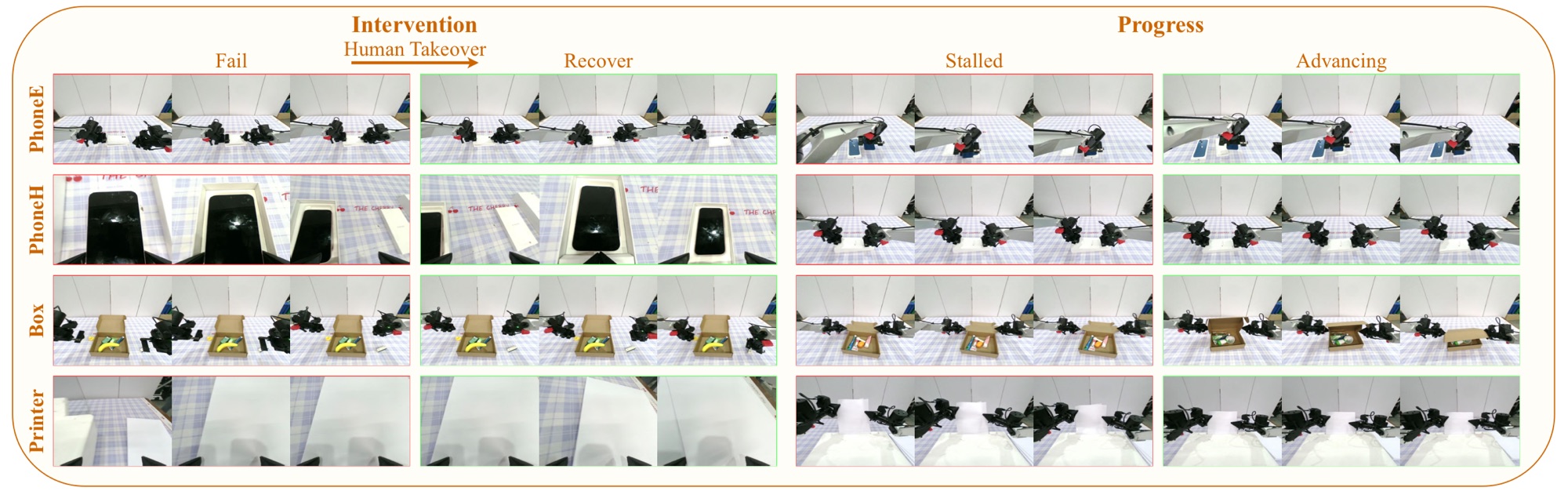
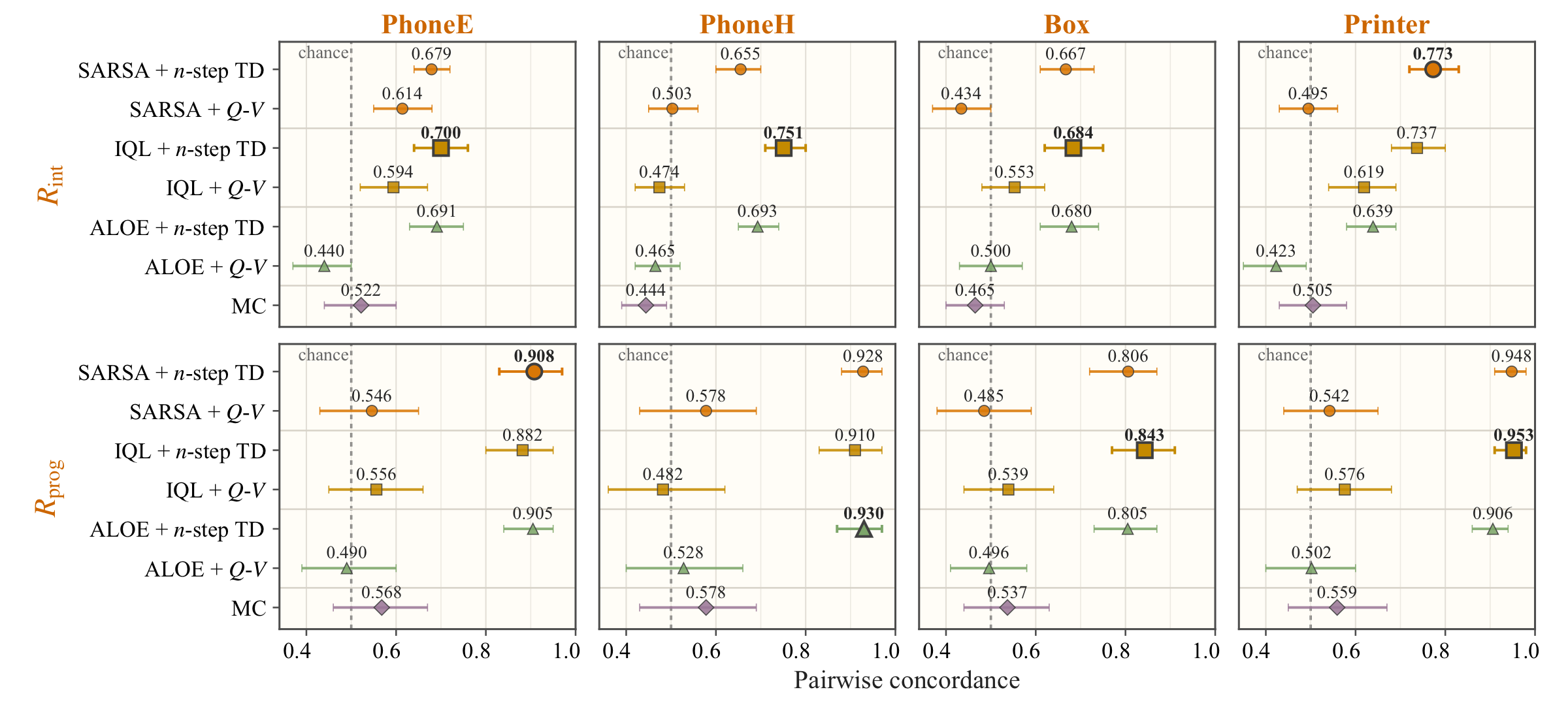
- Screened by two ordering diagnostics: Rint, Rprog
Advantage-guided reinforcement learning provides a practical way to post-train vision-language-action (VLA) policies using limited robot data. However, its performance depends on several coupled choices, including how critic-derived advantages are constructed, calibrated, and used for policy training. Existing recipes often combine these choices into a single end-to-end procedure, making their individual effects difficult to identify.
In this work, we dissect advantage-guided VLA post-training through a controlled empirical study that separates these design choices while accounting for their distinct estimands. We develop stage-specific offline evaluation methods to screen alternative choices efficiently, without requiring extensive real-robot policy evaluations for every possible combination. The staged evaluation identifies a modular recipe that combines temporal-difference advantage construction, group-wise calibration, and continuous advantage weighting. Across four real-world bimanual tasks, the resulting recipe improves mean task progress and success over the SFT initialization by 0.42 and 0.63, respectively. Moreover, the proposed evaluation diagnostics show an overall alignment with downstream real-world performance, supporting their use for interpreting empirical outcomes and selecting advantage-guided post-training designs in practice.
We decompose advantage-guided post-training into construction, calibration, and utilization.
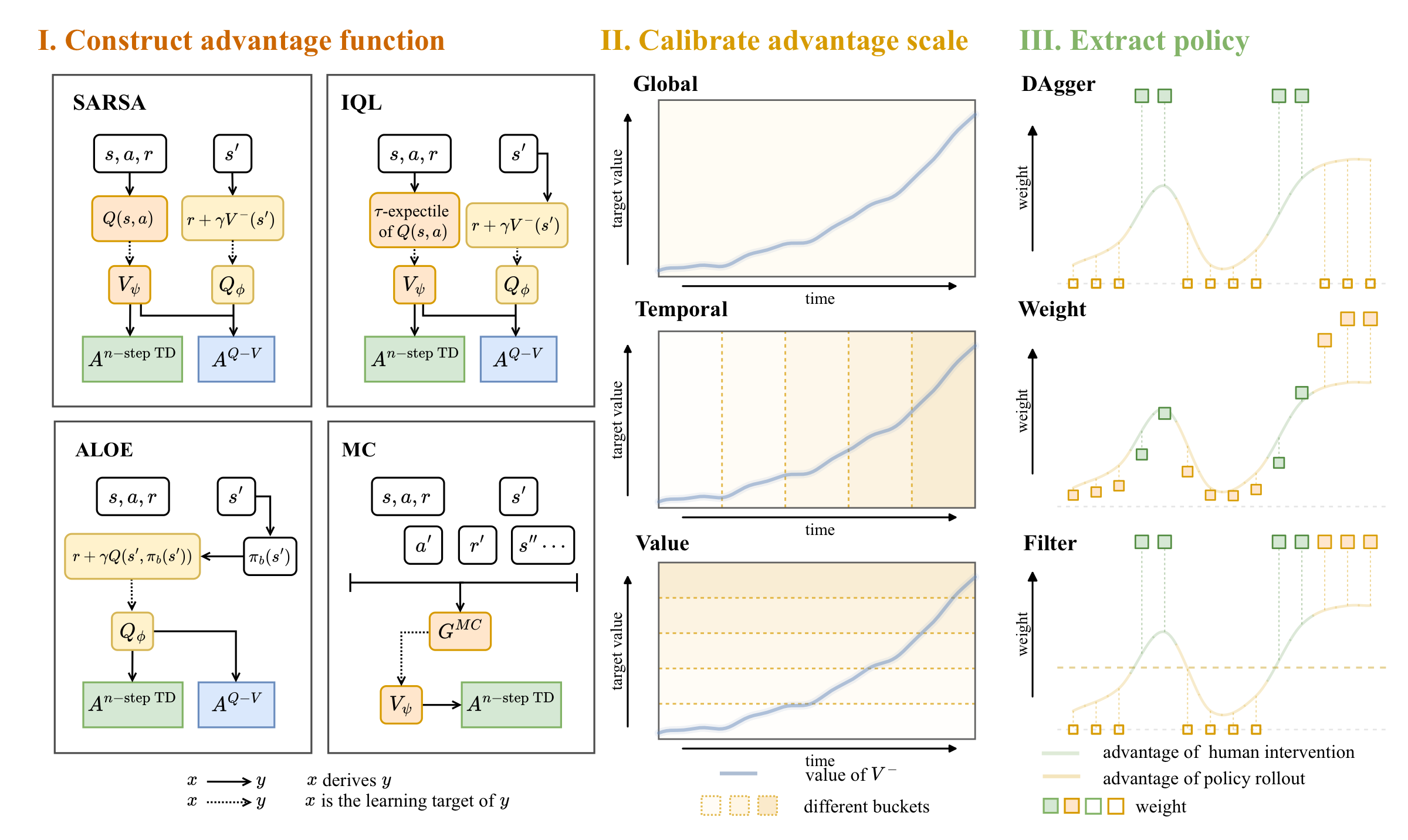
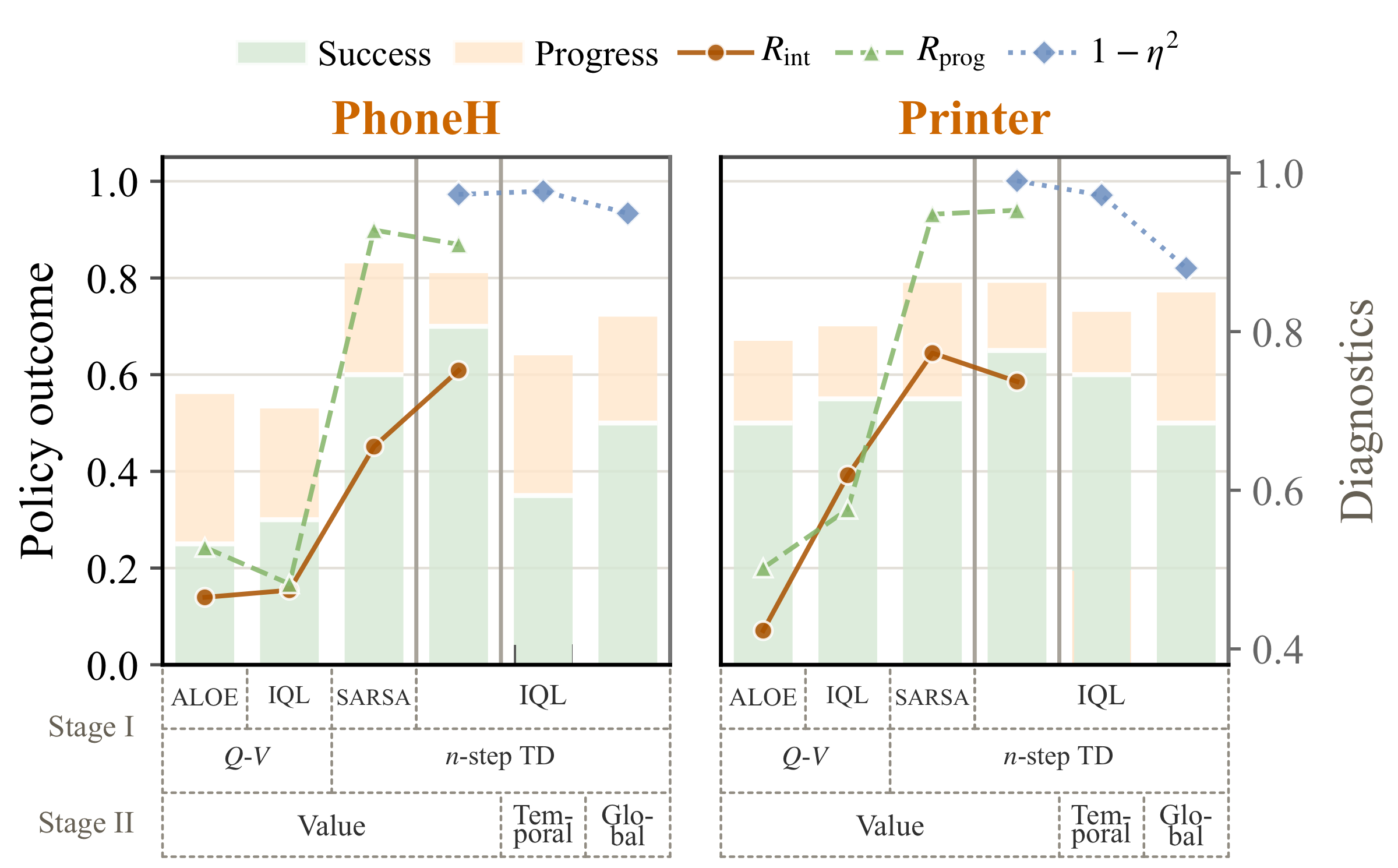
Stage I asks which advantages recover the expected quality orderings among dataset actions. Because the compared constructions estimate different quantities, we evaluate the orderings they induce instead of their raw values.
Stage II asks whether calibrated advantages stay comparable across sub-tasks.
| Calibration | PhoneE | PhoneH | Box | Printer | Mean |
|---|---|---|---|---|---|
| Raw | 0.072 | 0.063 | 0.106 | 0.127 | 0.092 |
| Global | 0.057 | 0.051 | 0.090 | 0.120 | 0.080 |
| Temporal | 0.071 | 0.023 | 0.053 | 0.028 | 0.044 |
| Value | 0.053 | 0.027 | 0.013 | 0.010 | 0.026 |
Four bimanual manipulation tasks on a platform with two 6-DoF arms and three RGB fisheye cameras. The policy predicts chunks of 30 end-effector actions executed at 30 Hz.
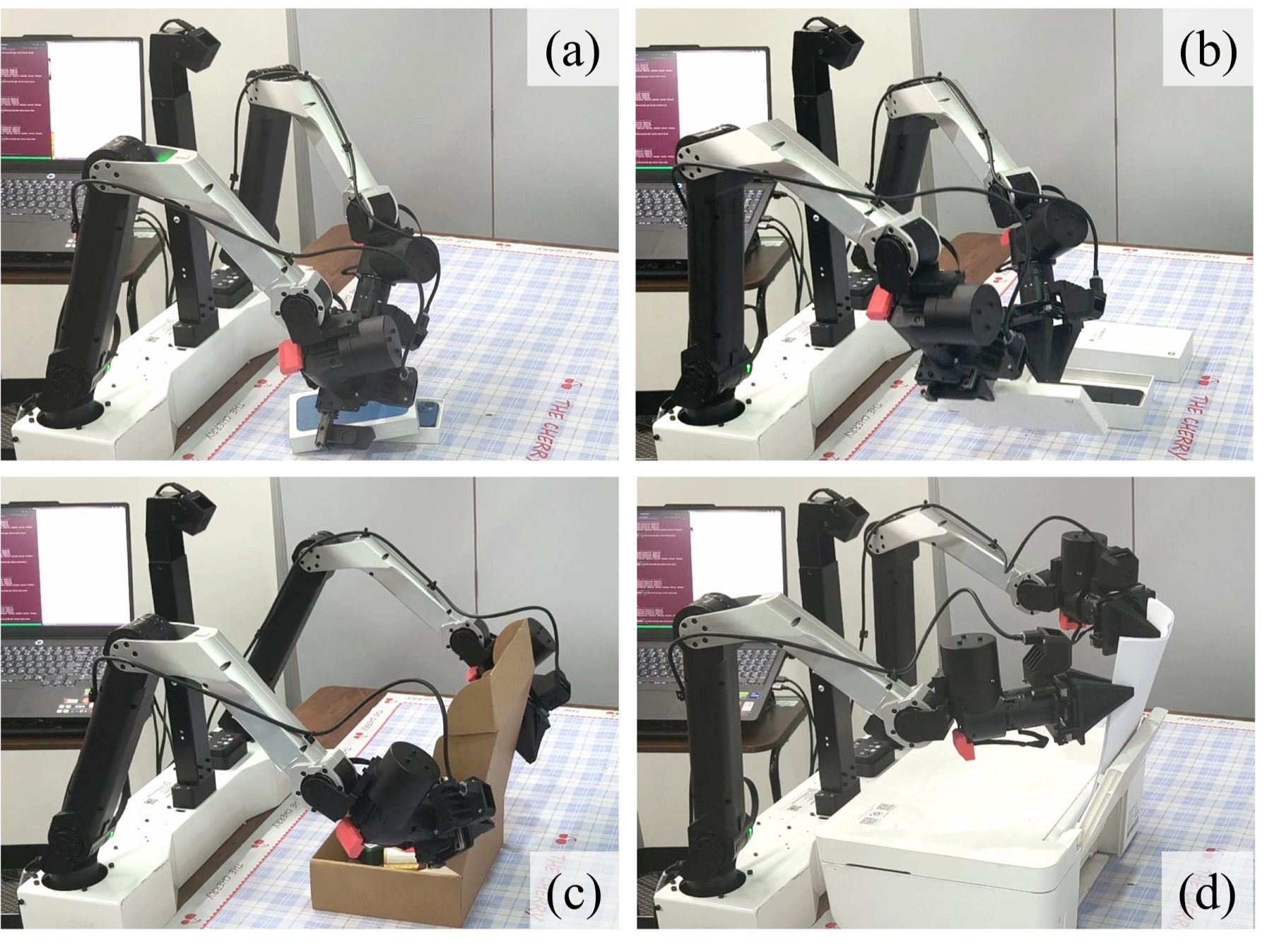
Places a phone into its packaging box and closes the lid.
A more complex box plus an accessory-insertion step, giving a longer horizon and higher difficulty.
Places three objects into a carton, folds the flaps, and presses the side tabs to close it.
Picks up a small stack of paper and loads it into the printer tray.
All conditions start from the same SFT checkpoint and share data, budget, and evaluation schedule; only the per-sample weight differs. Each task column averages 20 real-robot trials per condition.
| Task progress | Task success | |||||||||
|---|---|---|---|---|---|---|---|---|---|---|
| Condition | PhoneE | PhoneH | Box | Printer | Mean | PhoneE | PhoneH | Box | Printer | Mean |
| SFT Init | 0.50 | 0.32 | 0.69 | 0.24 | 0.44 | 0.30 | 0.00 | 0.15 | 0.00 | 0.11 |
| DAgger | 0.65 | 0.62 | 0.91 | 0.66 | 0.71 | 0.35 | 0.30 | 0.70 | 0.45 | 0.45 |
| Weight (ours) | 0.88 | 0.81 | 0.95 | 0.79 | 0.86 | 0.80 | 0.70 | 0.80 | 0.65 | 0.74 |
| Filter | 0.78 | 0.69 | 0.91 | 0.60 | 0.75 | 0.70 | 0.40 | 0.55 | 0.35 | 0.50 |
Policy rollouts on each of the four tasks, executed by the Weight condition from the table above.
Pack Phone Easy — places a phone into its packaging box and closes the lid.
Keeping the Weight rule fixed, we change one earlier stage at a time and re-evaluate on PhoneH and Printer: the first four conditions vary the Stage-I construction, the last three vary the Stage-II calibration, and the shared fourth condition is the reference recipe above. Higher Stage-I concordance and lower Stage-II η2 come with higher real-world progress and success, which is what licenses screening these choices offline.
Complete walkthrough of the study: the three staged comparisons, results, and uncut real-robot rollouts.
@article{cao2026dissecting,
  title   = {Dissecting Advantage-Guided Post-Training for Vision-Language-Action Policies},
  author  = {Cao, Jiahang and Zhao, Hanye and Lai, Hang and Zhang, Shenyu and Han, Xiaoshen
             and Li, Xinghang and Liu, Futeng and Peng, Wanli and Wang, Heyun
             and Wang, Yunhong and Li, Jason and Yu, Yong and Zhang, Weinan},
  year    = {2026}
}